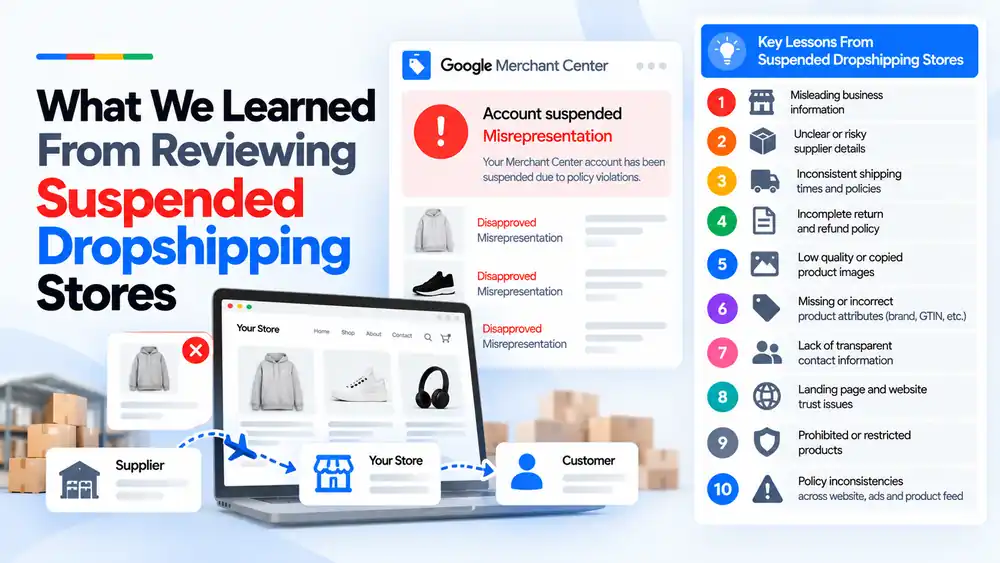
Dropshipping is allowed in Google Merchant Center. The suspended dropshipping stores we review almost never fail because of the business model itself. They fail because the store hides who runs it, promises shipping times and policies the supplier cannot meet, uses copied images and data, or tells a different story on the website, in the feed and in ads. Fix transparency and consistency first, then request review.
Last updated: 3 October 2026 · By Ashraful Islam, founder of GMC Fixer
Over 5+ years of fixing suspended Merchant Center accounts, dropshipping stores have become one of the most common cases we see. The good news is that the same problems come up again and again, which means they are predictable and fixable. This guide shares the lessons we have learned from reviewing suspended dropshipping stores, what we usually find, and what to change before you ask Google for another review.
If you want the step-by-step recovery process for a dropshipping account, read our Google Merchant Center dropshipping suspension guide. This article focuses on the patterns behind those suspensions.
Why dropshipping stores get suspended more often
Google does not treat dropshipping as a violation. The issue is that a dropshipping store depends on someone else for products, stock, images and delivery. Every one of those dependencies can create a gap between what the store promises and what the customer actually experiences. Google reviewers and automated systems look for exactly those gaps.
- Products and data come from a supplier, so titles, images and attributes are often copied or incomplete.
- Fulfilment is out of your hands, so shipping times and tracking can differ from what the store says.
- Stores are launched quickly, often from templates, with thin business information and generic policies.
- Many similar stores exist, which makes trust signals and originality more important.
10 lessons from suspended dropshipping stores
These are the issues we see most often. A store rarely has just one; usually three or four of them appear together.
1. Misleading or missing business information
What we see: no business name, no address, an About page written like a brand story with no real details, or claims such as “our warehouse” when the store has none. The fix: state who runs the store, where the business is based and how it operates. Do not present yourself as a manufacturer or local warehouse if you are not one. Our misrepresentation policy guide covers this in more detail.
2. Unclear or risky supplier details
What we see: products that ship from another country while the store implies local stock, or suppliers with unreliable delivery and quality. The fix: work with suppliers you can rely on, be honest about where orders ship from, and remove products whose fulfilment you cannot stand behind.
3. Inconsistent shipping times and policies
What we see: “Fast free shipping” on the homepage, 3 to 5 days in the feed, and 10 to 20 days in the shipping policy. The fix: use the real delivery window from your supplier, including processing time, and make the website, checkout and Merchant Center shipping settings match. See our guide to shipping mismatch issues.
4. Incomplete return and refund policy
What we see: template policies with placeholder text, no return address, no timeframe, or rules that contradict each other. The fix: write a clear policy that explains the return window, condition requirements, who pays return shipping, where items go and how refunds are issued. Make sure it is easy to find from every page.
5. Low quality or copied product images
What we see: supplier images with watermarks, mixed styles, text overlays or pictures that do not match the actual product. The fix: use clean, accurate images of the item customers will receive, without promotional overlays or another seller’s branding.
6. Missing or incorrect product attributes
What we see: invented brand names, made-up GTINs, wrong colours or sizes, and titles stuffed with keywords. The fix: only submit identifiers that are genuinely assigned to the product and keep attributes accurate. Our guides on missing GTINs and the brand attribute explain the rules.
7. Lack of transparent contact information
What we see: a contact form only, a free email address, no phone number and no response time. The fix: give customers at least two clear ways to reach you, show a business email on your own domain, and state when they can expect a reply.
8. Landing page and website trust issues
What we see: broken pages, unfinished sections, lorem ipsum text, fake countdown timers, unrealistic discounts and invented reviews. The fix: remove anything fake or unfinished, make sure every product URL loads properly, and only show real reviews. Read our guide to website needs improvement warnings.
9. Prohibited or restricted products
What we see: trending supplier catalogues that include replica items, health claims, weapons accessories or other restricted products added without checking. The fix: review every product against Google Shopping policies before importing it, and remove anything that is prohibited or needs certification you do not have.
10. Policy inconsistencies across website, ads and feed
What we see: one price on the site, another in the feed, a different promise in ads and a different return window in the policy. The fix: treat the website as the single source of truth and make the feed, Merchant Center settings and ads match it exactly.
Lessons at a glance
| Lesson | Common mistake | What to do instead |
|---|---|---|
| Business information | Hidden owner, fake warehouse claims | Clear business details and honest About page |
| Supplier details | Implied local stock | Accurate ship-from location and reliable suppliers |
| Shipping | Promises faster than reality | Real delivery windows everywhere |
| Returns and refunds | Template or contradictory policy | Complete, specific, easy-to-find policy |
| Product images | Watermarks, overlays, mismatched photos | Clean, accurate images of the real item |
| Product attributes | Invented brands and GTINs | Only genuine identifiers and accurate data |
| Contact information | Form only, no reply time | Multiple contact options and response time |
| Website trust | Fake timers, fake reviews, broken pages | Finished pages and real reviews only |
| Restricted products | Unchecked supplier catalogue | Policy check before importing |
| Consistency | Different claims in site, feed and ads | One source of truth for every detail |
What these lessons have in common
Almost every suspended dropshipping store we review has the same underlying problem: the store looks like it was set up to sell quickly rather than to be accountable to customers. Google wants to know that a real business stands behind the store and that customers will get what is promised. Supplier transparency, honest shipping times and consistent information are what make that clear.
We see similar patterns outside dropshipping too. For the wider picture, read 10 patterns we keep seeing in failed Merchant Center reviews.
A practical order of fixes
- Audit the business identity. Update the About and contact pages with real business details and remove any misleading claims.
- Confirm supplier reality. Check real processing and delivery times, where orders ship from and how returns are handled.
- Rewrite the policies. Shipping, returns, refunds, privacy and terms should match what actually happens.
- Clean the catalogue. Remove restricted products and anything you cannot fulfil reliably.
- Fix product data. Correct titles, images, brands, identifiers, prices and availability.
- Align Merchant Center and ads. Make shipping settings, feed data and ad claims match the website.
- Request review once. Only when everything above is complete.
Quick checklist before requesting review
- Business name, location and contact details are visible and accurate
- About page describes how the business really operates
- Shipping times include processing and match the supplier
- Return and refund policy is complete and consistent
- Product images are clean and match the real items
- Brand and GTIN values are genuine or left out correctly
- No fake reviews, timers or unfinished pages
- No prohibited or restricted products
- Prices and availability match between site and feed
- Ads make the same claims as the website
For a broader list, use our Google Merchant Center suspension checklist.
What not to do
- Do not open a new account to get around the suspension. Read why in our guide to a new Merchant Center account after suspension.
- Do not request reviews repeatedly without making real changes.
- Do not hide the fact that orders ship from overseas.
- Do not copy policies from another store without editing them for your business.
- Do not add trust badges, guarantees or reviews that are not genuine.
Dropshipping store vs trusted store
| Area | Typical suspended store | Store ready for review |
|---|---|---|
| Identity | No owner or location | Clear business details |
| Shipping | “Fast shipping” with no timeframe | Specific, realistic delivery window |
| Returns | Generic template | Specific process and address |
| Products | Copied images and data | Accurate images and attributes |
| Trust | Fake urgency and reviews | Real reviews and honest offers |
Related reading: dropshipping suspension fix, misrepresentation guide and common problems found in suspended stores.
How GMC Fixer approaches dropshipping suspensions
We start with a full review of the store, the feed and the Merchant Center account, then list every issue that could block reinstatement. For dropshipping stores, we pay close attention to business transparency, supplier and shipping details, policies and product data. We then help you fix each one in the right order and prepare a single, strong review request. Learn more about our Google Merchant Center suspension fix service.
FAQ
Does Google ban dropshipping stores in Merchant Center?
No. Dropshipping is allowed. Google suspends stores for policy problems such as misrepresentation, unclear business information, inaccurate shipping or return details and unreliable product data. Dropshipping stores simply tend to have more of these gaps because the products, images and fulfilment come from someone else.
What is the most common reason dropshipping stores get suspended?
In the stores we review, the most common root cause is a lack of transparency: missing or vague business details, no clear contact information, and policies that do not match what really happens after an order is placed. Google usually labels this as misrepresentation.
Do I need to name my supplier on my website?
Not necessarily. What matters is that customers know who they are buying from, where orders ship from, how long delivery really takes and how returns work. Your own business must be clearly identified and accountable, even if fulfilment is handled by a supplier.
Can I use supplier product images and descriptions?
You can, but copied images and text are a common trust problem. Images with other store watermarks, inconsistent styles or claims you cannot support weaken the store. Write your own descriptions and use clean, accurate images for the products you actually ship.
How long should I wait before requesting another review?
Only request a review once every issue is fixed across the website, the product feed and any ads. Repeated requests on an unchanged store can lead to longer cool-down periods, so it is better to submit one complete, well-prepared review.
Related guides
- Google Merchant Center Dropshipping Suspension: How to Fix It
- 10 Patterns We Keep Seeing in Failed Merchant Center Reviews
- Misrepresentation Policy Violations Guide
- Google Merchant Center Suspension Checklist
- Google Merchant Center Review Failed: Why It Happens
- Google Merchant Center Review Button Disabled: What the Cooldown Period Means
- Google Merchant Center Product Page Blocked by Robots.txt: How to Fix Googlebot Access
- Google Merchant Center Automatic Updates: Should You Enable Them?
Get a free review of your account
If your dropshipping store has been suspended, send us the details and we will review your store and account for free. Contact us here. We reply within 24 hours.
Leave a Reply