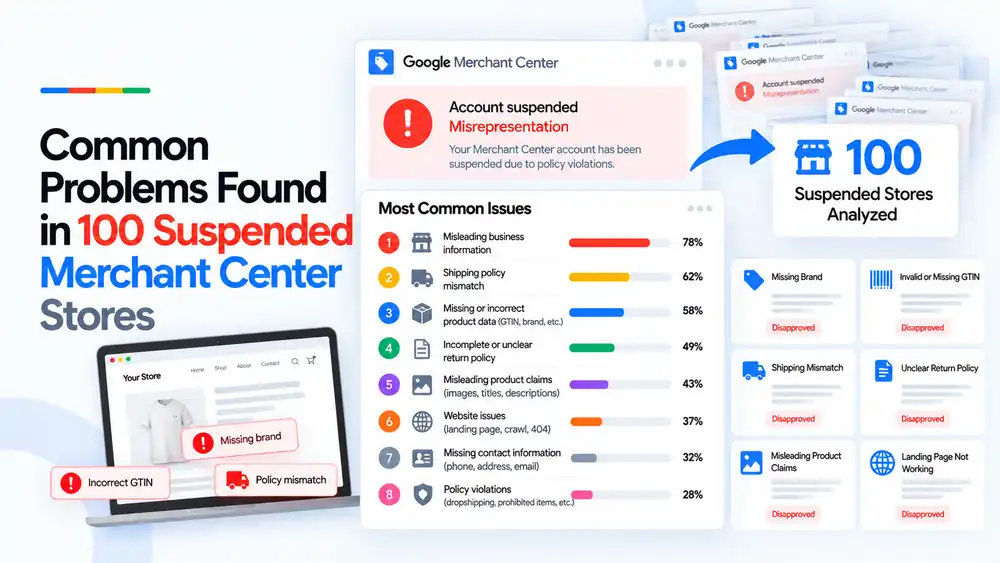
Across 100 suspended Merchant Center stores we reviewed, the most common problem was misleading business information (78% of stores), followed by shipping policy mismatches (62%) and missing or incorrect product data (58%). Most stores had several issues at once, which is why fixing only one thing so often leads to a failed review.
Last updated: 3 October 2026 · By Ashraful Islam, founder of GMC Fixer
In 5+ years of fixing Google Merchant Center accounts, we have seen the same problems come up again and again. To put numbers on it, we looked back at 100 suspended stores we reviewed and recorded every issue we found. Here is what came up most often, and what to do about each one.
How we counted
Each of the 100 stores came to us with a suspended Merchant Center account. During the audit we noted every issue that could affect the review, not just the policy named in the notice. Most stores had more than one problem, so the percentages below add up to more than 100%.
The most common issues at a glance
| Issue | Stores affected |
|---|---|
| 1. Misleading business information | 78% |
| 2. Shipping policy mismatch | 62% |
| 3. Missing or incorrect product data (GTIN, brand, etc.) | 58% |
| 4. Incomplete or unclear return policy | 49% |
| 5. Misleading product claims (images, titles, descriptions) | 43% |
| 6. Website issues (landing page, crawl, 404) | 37% |
| 7. Missing contact information (phone, address, email) | 32% |
| 8. Policy violations (dropshipping, prohibited items, etc.) | 28% |
What each issue looked like, and how to fix it
1. Misleading business information (78%)
The most common problem by far. Typical examples: no business name or address on the site, a different name in Merchant Center, or an address that does not match the policy pages. Google needs to be able to tell who runs the store. Use the same business details everywhere. Our misrepresentation guide covers this in detail.
2. Shipping policy mismatch (62%)
Shipping costs or delivery times on the site did not match the shipping policy page or the Merchant Center shipping settings. “Free shipping” banners with hidden conditions were a frequent cause. See shipping mismatch and free shipping claims.
3. Missing or incorrect product data (58%)
Missing or invalid GTINs, missing brands and missing attributes like color, gender and age group. These usually cause item disapprovals, but they add to the picture of a store that is not well maintained. Start with missing GTIN and product feed errors.
4. Incomplete or unclear return policy (49%)
Return policies copied from a template, missing a return window, or not saying who pays for return shipping. A clear policy tells shoppers how many days they have, what condition items must be in and how refunds are paid.
5. Misleading product claims (43%)
Images that do not match the product, titles with claims the product cannot back up, fake discounts and countdown timers. Every claim on the page should be accurate and provable.
6. Website issues (37%)
Broken product pages, 404 errors, pages blocked from Google’s crawler or a checkout that did not work. If Google cannot load the page, it cannot approve it. See landing page not working.
7. Missing contact information (32%)
Only a contact form, with no email, phone number or address. Shoppers and Google want more than one way to reach a real business.
8. Policy violations (28%)
Prohibited or restricted items, counterfeit-looking products, or dropshipping set-ups with unclear sellers and delivery times. Some of these need product or supplier changes, not just page edits. See dropshipping suspension.
What this means for your store
- Expect more than one issue. Most stores we reviewed had several problems. Audit everything, not just the policy named in the notice.
- Start with business information. It was the most common issue, and it is usually quick to fix.
- Line up shipping and returns. Make the site, policy pages and Merchant Center settings say the same thing.
- Clean up the feed. Fix GTINs, brands and attributes so product data matches each landing page.
- Remove anything misleading. Check banners, timers, badges, titles and images.
- Test the site. Make sure product pages load and checkout works on mobile and desktop.
- Request a review only when everything is done.
Quick checklist
- Business name, address, phone and email consistent everywhere
- Shipping costs and times match site, policy and Merchant Center
- GTINs, brands and attributes complete and correct
- Return policy clear: window, condition, costs, refunds
- No misleading images, titles, discounts or timers
- Every product page loads and checkout works
- No prohibited or restricted products
- Multiple ways to contact the business
For the full step-by-step audit, use our Google Merchant Center suspension checklist.
What not to do
- Don’t assume the policy named in the notice is the only problem.
- Don’t fix one issue and request a review straight away.
- Don’t add made-up addresses, fake reviews or trust badges.
- Don’t open a new Merchant Center account to get around the suspension.
Account-level vs. product-level issues
| Account-level issues | Product-level issues | |
|---|---|---|
| Examples | Business information, policies, misleading claims, policy violations | GTIN, brand, attributes, price or availability mismatch |
| Typical result | Account suspension | Individual products disapproved |
| Main fix | Site-wide changes, then a review request | Feed and landing page fixes |
If a review has already failed, read what to fix before requesting another review.
How GMC Fixer approaches suspended stores
Because most stores have several issues, we audit the whole account: business details, policies, claims, product data and the website itself. We fix the gaps in order of impact and only then prepare the review request. Learn more about our Google Merchant Center suspension fix service.
FAQ
Why do the percentages add up to more than 100%?
Most suspended stores had more than one problem. A single store could have misleading business information, a shipping mismatch and missing GTINs at the same time, so it counts towards each of those issues.
What is the most common reason for a Merchant Center suspension?
In the stores we reviewed it was misleading business information: missing or inconsistent business name, address, phone or email, or details that did not match Merchant Center. It appeared in 78% of the stores.
My notice says misrepresentation. Which of these issues apply to me?
Misrepresentation is broad. Business information, shipping and return policies, misleading claims and missing contact details can all feed into it. That is why a full audit usually finds several issues, not just one.
Do product data issues cause account suspensions?
Missing or incorrect GTINs, brands and attributes usually cause item disapprovals rather than full suspensions. But they showed up in 58% of suspended stores, and they make it harder to pass a review because they add to the overall picture of an unreliable store.
How long does it take to fix these issues?
It depends on how many issues the store has and how big it is. Many stores can fix business details and policy pages in a few days. Product data and site issues on large catalogues can take longer.
Related guides
- Misrepresentation Policy Violations Guide
- Why Google Merchant Center Suspends Accounts
- Google Merchant Center Suspension Checklist
- Google Merchant Center Review Failed
- 10 Patterns We Keep Seeing in Failed Merchant Center Reviews
- What We Learned From Reviewing Suspended Dropshipping Stores
- Google Merchant Center Review Failed: Why It Happens
- Google Merchant Center Review Button Disabled: What the Cooldown Period Means
- Google Merchant Center Product Page Blocked by Robots.txt: How to Fix Googlebot Access
- Google Merchant Center Automatic Updates: Should You Enable Them?
Get a free review of your account
Want to know which of these issues your store has? Send us your store details and we’ll point them out. We reply within 24 hours.
Leave a Reply