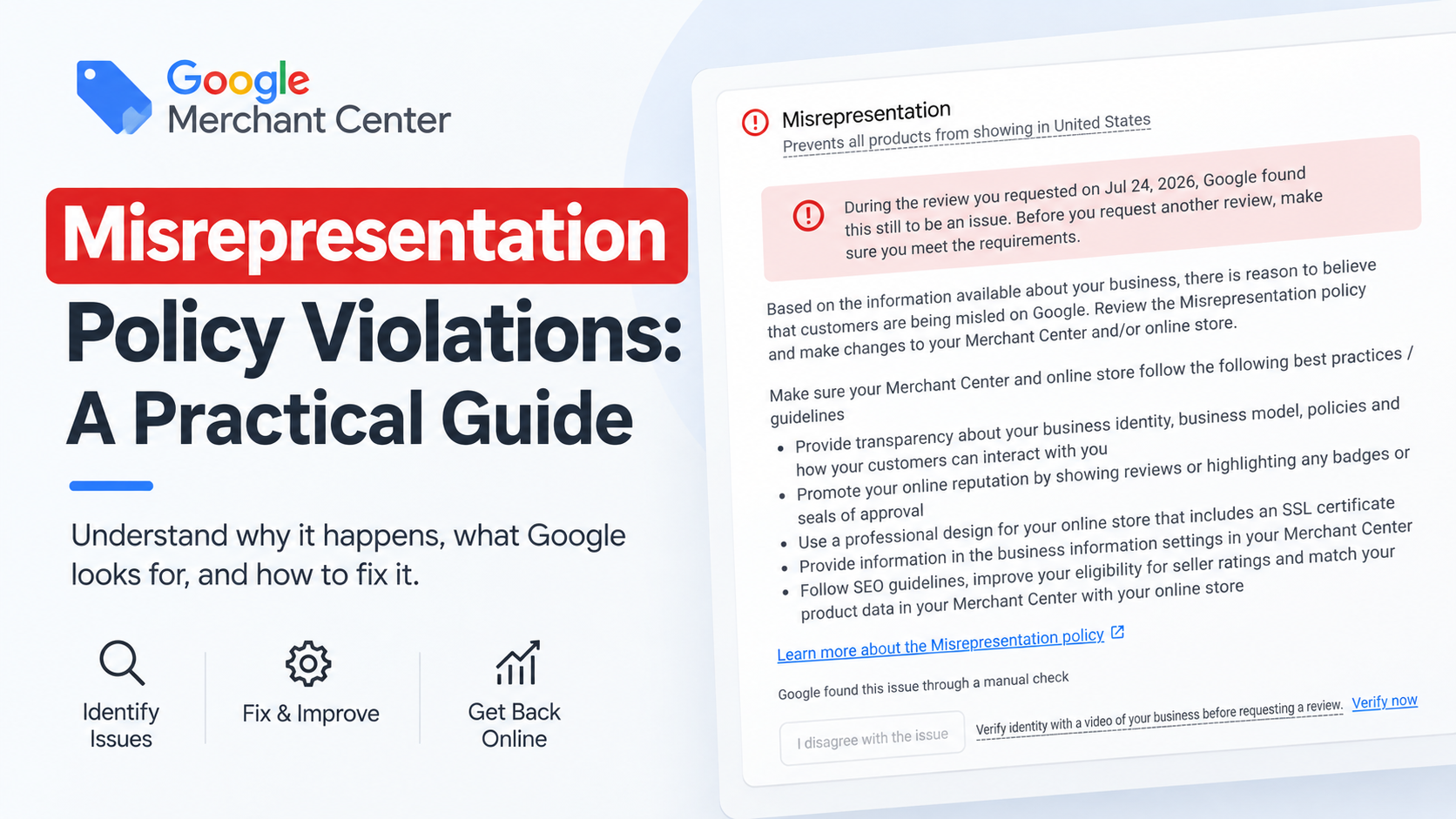
Misrepresentation is Google Merchant Center’s broadest policy category, and it’s the single most common reason accounts get suspended. It covers anything that misleads shoppers about who they’re buying from, what they’re buying, or the terms of the purchase — which means a misrepresentation suspension can be triggered by a business-identity problem, a website content problem, or a product-data problem, often all at once. Fixing it means identifying which of those it actually is, not guessing.
What counts as misrepresentation
Google groups a wide range of issues under this one policy. In practice, most misrepresentation suspensions come down to one of these:
- Unclear business identity — no visible business name, or a business name on the website that doesn’t match what’s registered in Merchant Center.
- Missing or hard-to-find contact information — no working email, phone number, or physical address a shopper could actually use to reach you.
- Unclear or missing policies — no visible return policy, refund policy, or shipping policy, or one that contradicts what’s shown at checkout.
- Deceptive pricing or claims — a price, discount, or product claim on the site that doesn’t hold up (fake countdown timers, inflated “original” prices, unsubstantiated claims).
- Site under construction or incomplete — placeholder pages, broken checkout, or a store that isn’t actually functional yet.
Why this policy catches so many accounts
Misrepresentation is a catch-all by design — Google uses it whenever something about a store doesn’t add up to a shopper, even if no single element is dramatically wrong on its own. A store with a slightly mismatched business name, a returns page that’s technically there but hard to find, and a generic contact form instead of a real email can add up to a misrepresentation flag even though each piece looks minor in isolation. That’s why a full, honest audit of the site matters more than fixing the one thing Google happened to mention.
What to check first
Before appealing, go through the site the way a reviewer would: is the business name the same everywhere (website, checkout, Merchant Center, WHOIS/domain registration if it’s checked)? Is there a real, monitored contact method — not just a contact form that routes nowhere? Are shipping, return, and refund policies published, accurate, and consistent with what’s actually offered at checkout? Is every page on the site fully built, with no placeholder or “coming soon” content live?
How this differs from a product-level disapproval
A misrepresentation issue is almost always about the business or the website as a whole, not one product listing — which is why it usually causes an account-level suspension rather than a single disapproval. That also means the fix has to happen at the website/business level (see our guide on why Google Merchant Center suspends accounts for how this compares to other suspension causes like product feed errors).
Preventing a repeat misrepresentation flag
Once resolved, keep business name and contact details identical across your website, Merchant Center, and any other platform you sell on, and re-check your policy pages whenever you change your shipping carrier, return window, or refund process — a policy page that quietly goes stale is a common reason this issue resurfaces months later.
How GMC Fixer approaches misrepresentation suspensions
We audit the full site against Google’s misrepresentation criteria — business identity, contact information, policies, and site completeness — rather than reacting to only the one detail Google’s message mentions, then fix what’s actually missing or inconsistent before preparing the appeal, as part of our Google Merchant Center suspension recovery service. See our guide on what to expect during reinstatement for how the appeal process itself works once the fix is in place.
Get a free review of your account
If your Google Merchant Center account was suspended for misrepresentation, get a free account review to find out exactly what’s triggering it and what fixing it actually involves.
Leave a Reply